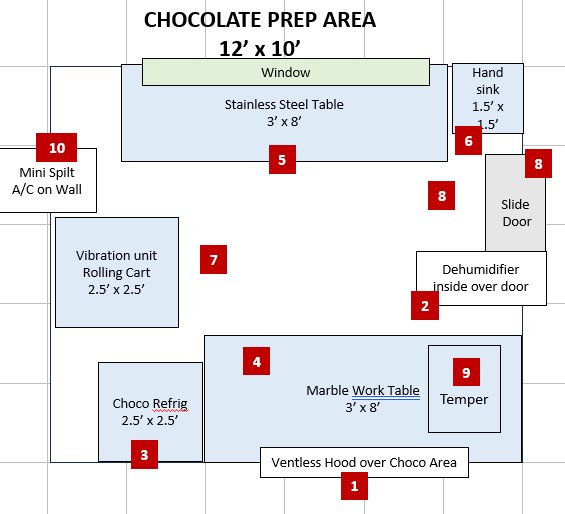
Layout Overview
Environmental targets are non-negotiable for chocolate quality: 65–70°F, 40–50% RH, air velocity under 50 fpm at the work surface. The mini-split + standalone dehumidifier combination is what delivers those targets — and is the single biggest dollar-line in the room after the prep-table refrigeration.
| Slot | Allocated | Notes |
|---|---|---|
| Ventless hood | — | Installed ~24–36″ above the cook worktable |
| Standalone dehumidifier | 30–50 pt/day | Mounted high on north wall above sliding door; drains to wash-room floor sink |
| Reach-in refrigerator (west wall) | 30″ | Callets, fillings, ganache aging — chocolate-only |
| Marble work table (west wall) | 66″ | Tempering surface, 3′ × 5.5′ marble slab on stainless frame |
| Stainless prep table (east wall) | 84″ | Top is millwork; 2× 24″ UC fridges underneath |
| Hand sink (south wall, near door) | 15″ | NC code, dedicated handwashing |
| Vibration table + rolling cart | — | Lifted onto marble for molding; cart docks under prep table |
| Sliding door | — | Brush-sealed; humidity barrier between rooms |
| Tempering machine (countertop) | ~16″ × 18″ | Sits on east-wall prep table |
| Mini-split (dedicated thermal zone) | 9k–12k BTU | Wall-mount head + outdoor condenser |
Ventless Hood
Installed ~24–36″ above the cook worktable. Commercially rated system; key certifications to require are UL 710B, NSF, and NFPA 96 compliance. A commercial-grade UL 710B recirculating hood for an 8-foot span will run $3,500–$7,000 installed.
The three tiers to consider
- Workhorse: CaptiveAire Upblast Recirculating Series or an Accurex recirculating hood sized to your 8-foot table.
- Premium with fire suppression: Halton’s RECIRCOJET system — integrated fire suppression built in.
- Best particulate capture: Some recirculating units deploy electrostatic precipitator filtration in conjunction with media filters and carbon, which gives you better cocoa particulate capture and longer filter life between services. Budget an 18,000 BTU unit (12,000 BTU minimum).
Standalone dehumidifier with humidistat
Slot 10A mini-split alone holds temperature but won’t reliably hold humidity below 50% RH in a closed 90-sq-ft room with active production — the cooling cycles aren’t long enough to dehumidify aggressively. A dedicated dehumidifier with a humidistat runs independently to hold 40–45% RH regardless of what the mini-split is doing.
| Model | Aprilaire E070 (free-standing or ducted) · budget alternative: Frigidaire FFAD5033W1 (50 pt residential) |
|---|---|
| Price (est.) | Aprilaire E070: $1,200–1,500 · Frigidaire residential: $280–380 |
| Dimensions | 21″ W × 14″ D × 27″ H. 70 pt/day at 80°F/60% RH (de-rated to ~40 pt at 65°F/45% RH). Built-in humidistat 35–80% RH adjustable. Continuous drain via 5/8″ hose. 115V standard outlet. |
| Why this one | The Aprilaire is commercial-grade, the humidistat is accurate, and the drain runs continuous (no bucket to empty). The Frigidaire residential is one-quarter the price and works fine for 2–3 years; if budget is tight at opening, start there and upgrade in year 2. |
Reach-in refrigerator (west wall)
Slot 11| Model | True T-23-HC (27″ W actual) · upgrade: Traulsen RHT132N |
|---|---|
| Price (est.) | True T-23-HC: $3,200–4,200 · Traulsen RHT132N: $5,800–7,400 |
| Dimensions | 27″ W × 29.5″ D × 78″ H. 23 cu ft. Single solid stainless door, three adjustable shelves. 33–38°F factory; can be set to 50°F for chocolate. R290 hydrocarbon refrigerant, ENERGY STAR. Standard 115V/15A outlet. |
| Why this one | True T-23 is the workhorse single-section reach-in across NC restaurant kitchens — cheap, durable, the refrigeration tech in your area can fix one in their sleep. Note the actual width is 27″ (not 30″), which gives 3″ of side clearance in the west-wall layout — useful since the marble table next to it generates heat at the work surface. |
Marble work table (tempering surface)
Slot 12This is the chocolatier’s primary work surface. Unlike the back-bar pastry slab (where quartz is recommended for its non-porous, low-maintenance properties), the chocolate prep room marble table is the right place for actual marble — the thermal mass of natural marble is exactly what tempering benefits from.
| Model | Marble: 1.25″ Carrara honed slab, 36″ × 66″, food-safe sealed (local fabricator) · Base: Regency stainless 30″ × 72″ work table (top removed, marble slab installed) |
|---|---|
| Price (est.) | Marble fabricated: $900–1,400 · Stainless frame: $300–450 · Install/sealing: $200–400 · Total $1,400–2,250 |
| Why this one | Marble’s thermal mass is the property you want here: it stays cool, draws heat out of chocolate during tabling/tempering, and survives daily contact with melted callets without warping. Quartz won’t do this — engineered stone has half the thermal conductivity of natural marble. The honed (matte) finish over polished is preferred for tempering: less glare, better visibility on dark chocolate film thickness. |
Stainless prep table (east wall)
Slot 13The east-wall prep table is the dual-purpose surface — chocolate mise Wed–Sat, brunch mise Sundays. The 7-foot stainless top is custom millwork (welded by a stainless fabricator, no off-the-shelf 84″ × 30″ top exists at commercial grade), set on top of two 24″ under-counter refrigerators.
| Model | Advance Tabco 84″ × 30″ custom 16-gauge stainless top, marine edges all sides, no leg attachment |
|---|---|
| Price (est.) | $650–900 |
| Why this one | A standard work-table top with legs would be redundant here — the under-counter fridges are already 36″ tall and the top sits on them at the right working height (36″–37″). Spec’ing the top without legs saves ~$200, eliminates a cleaning gap between fridge top and table, and looks clean. 3–5 week lead time. |
Hand sink
Slot 15Same product as the wash room hand sink — wall-mount, NSF, gooseneck faucet, 17″ × 15″ footprint. NC code requires this sink in the chocolate prep room because it’s a separate food prep area from the wash room. Located on the south wall near the door to the BOH corridor so every staff member entering from the wash room or FOH triggers a handwash before touching production surfaces.
Price: $140–220. Regency 600HSWALLG.
Vibration table + rolling cart
Slot 16The vibration table eliminates air bubbles from molded chocolates after the polycarbonate molds are filled, and gives finished bonbons their professional shine and consistent fill.
| Model | Tomric Systems VT-M — 16″ × 20″ platform with side handles · alternative: Chocolate World 1010-CW |
|---|---|
| Price (est.) | Tomric VT-M: $1,400–1,900 · Cart: $200 |
| Why this one | Tomric is one of the recommended custom-mold suppliers, so buying the vibration table from the same vendor consolidates the relationship and ships everything in one order. The medium size is correctly specced for 4–6 active molds per day production volume; a larger unit is overkill and harder to lift. |
Sliding door with brush seals (to wash room)
Slot 17The sliding door between the chocolate prep room and the wash room is the humidity barrier between the two zones. The brush seals + dedicated mini-split keep the rooms thermally and humidity-isolated when closed.
| Price (est.) | Track: $200–340 · Brush seals: $120–180 · Bundle ~$320–520 |
|---|---|
| Why this one | Barn-door style sliding hardware is the right form factor — easier to install than a pocket door, doesn’t need wall-cavity work, and makes the door a visual feature in the BOH. Brush seals are non-negotiable for the humidity barrier; without them the dehumidifier runs constantly fighting moisture from the wash room. |
Tempering machine (countertop, 12 kg)
Slot 18This is the heart of the daily production workflow. Vol. II §8 sets your volume target at 100–150 finished pieces per night across 4–6 active varieties, totaling 4–6 molds per day with a single chocolatier working 25–30 hours/week. That maps cleanly to a small countertop tempering machine in the 12 kg (~25 lb) tank class.
| Model | Selmi Plus EX (12 kg / 25 lb tank, automatic tempering) · alternative: FBM Aura 12, ChocoVision Revolation X3210 (8 lb, smaller) |
|---|---|
| Price (est.) | Selmi Plus EX: $5,800–7,400 · ChocoVision X3210: $1,200–1,800 (budget option, 3.5 kg) |
| Why this one | Selmi is the gold standard for small-production chocolatiers — the Plus EX is found in every serious bonbon shop in Europe and a growing number in the US. The 12 kg capacity gives the chocolatier plenty of headroom to run two molds in parallel without re-tempering, and the wheel agitation keeps temper indefinitely during a 4–5 hour production session. |
Dedicated mini-split
Slot 9The mini-split is the single most important piece of equipment in the chocolate prep room. It needs to be sized to the active production heat load (8,000–12,000 BTU/hr from electric tempering equipment, two reach-ins, two under-counter fridges, and staff body heat) plus the cooling needed to hold 65–70°F against the building envelope.
| Model | Mitsubishi MSZ-FS12NA (indoor head) + MUZ-FS12NA (outdoor condenser) · alternatives: Daikin RXL12QMVJU, LG LSU120HSV5 |
|---|---|
| Price (est.) | $1,800–2,400 (equipment) · $1,800–2,800 (install) · installed total ~$4,000 |
| Why this one | Mitsubishi M-Series is the gold standard for small commercial mini-splits — quietest in class (19 dB indoor head at low fan), best low-temp heating performance for NC winters, and the local HVAC contractor network is strongest for Mitsubishi in the Triangle. |
The placement problem specific to chocolate
The mini-split needs to condition the entire space, but it absolutely cannot blow directly across the chocolate table. Cold moving air across tempered chocolate causes it to set unevenly and bloom; close enough to the chocolate zone to maintain 65–68°F; aim so airflow sweeps the room peripherally.
The best location
The optimal placement is on the opposite wall, high up. This gives you three advantages:
- It conditions both the chocolate zone and the prep zone from a single unit
- It directs airflow along the length of the room parallel to the worktables
- It keeps the unit away from the ventless hood’s capture zone directly above the chocolate table, so the two systems aren’t fighting each other
Routing the line set
A standard mini-split installation requires the line set — the refrigerant tubing and electrical conduit connecting the indoor wall unit to the outdoor compressor — to be routed through walls or ceiling. In an open deck space the line set runs exposed along the wall and up through the deck to the exterior compressor with simple conduit strapping. Fast, clean, and half the labor cost of a finished ceiling installation.
Where the compressor unit lives
The outdoor compressor does not have to go on the roof. Most common placement: either a concrete pad on the ground directly outside the exterior wall closest to your chocolate zone, or on a wall-mounted bracket a few feet off the ground.
- Compressor size: ~28″ × 28″ × 12″ (suitcase size), 60–80 lbs
- Keep line set run under 50 feet for efficiency
- 3″ core drill through an exterior wall is a far easier landlord ask than a roof penetration
Buy-List Summary — Chocolate Prep Room
| # | Slot | Recommended product | Est. price |
|---|---|---|---|
| 9 | Mini-split (12k BTU dedicated zone, installed) | Mitsubishi MSZ-FS12NA + MUZ-FS12NA + install | $3,600–5,200 |
| 10 | Standalone dehumidifier (with humidistat) | Aprilaire E070 (or Frigidaire residential at low end) | $280–1,500 |
| 11 | Reach-in refrigerator (27″) | True T-23-HC single-section reach-in | $3,200–4,200 |
| 12 | Marble work table (3′ × 5.5′) | Custom Carrara slab + Regency stainless frame | $1,400–2,250 |
| 13 | Custom stainless prep top (7′ × 30″) | Advance Tabco / John Boos custom no-leg top | $650–900 |
| 14 | Two under-counter refrigerators (24″ each) | True TUC-24-HC × 2 | $5,600–7,000 |
| 15 | Hand sink (15″ wall-mount) | Regency 600HSWALLG | $140–220 |
| 16 | Vibration table + rolling cart | Tomric VT-M + Regency utility cart | $1,560–2,160 |
| 17 | Sliding door hardware + brush seals | Real Carriage barn-door track + Pemko | $320–520 |
| 18 | Tempering machine (12 kg countertop) | Selmi Plus EX (or ChocoVision X3210 budget) | $1,200–7,400 |
| 19 | Polycarbonate molds (custom + standard) + smallwares | Tomric custom CC molds + standard library | $3,400–6,800 |
| Subtotal (low–high) | $21,350–38,150 | ||
Items to Confirm Before Placing Orders
- CRITICAL: Confirm with Durham AHJ that no Type I (grease) hood is required for the Tier 1 chocolate operation. This is the single biggest cost-saving validation in the BOH — saves $15K–50K vs. a standard kitchen hood.
- Decide between Aprilaire E070 ($1,200–1,500) and Frigidaire residential ($280–380). The Aprilaire is the right long-term answer; the Frigidaire is the right Year-1 budget answer.
- Decide between Selmi Plus EX and ChocoVision X3210. Hire the chocolatier first and let them weigh in.
- Lock in custom CC-monogram polycarbonate molds (Tomric, 4–8 week lead time) at least 8 weeks before opening.
- Confirm with the GC and electrical sub: dedicated 240V circuit for the mini-split, dedicated 208/230V/30A circuit for the dishwasher, standard 115V outlets at every other equipment location plus the dehumidifier.
- Coordinate the marble slab order with the back-bar pastry slab order if going with the same Triangle stone fabricator — combined order may earn a 5–10% discount.